This guide contains affiliate links. If you book through them we may earn a commission, at no extra cost to you. Learn more.
Hawaiʻi Volcanoes National Park is the one place on the Big Island we tell every visitor to see, and the one place most people plan badly. They roll in from Kona at midday, circle a full parking lot, squint at a steaming crater from behind a closure sign, and drive home.
This guide is for doing it yourself, and doing it well: what’s open right now, how to time the stops, what to pack for a summit about 4,000 feet up, and where to sleep so you aren’t spending the day in the car. If you’d rather hand the logistics to a guide, our volcano tour comparison lines up every option.
Status check: as of October 18, 2026
Kīlauea’s summit has been erupting in episodes since December 23, 2024: bursts of lava fountaining inside Halemaʻumaʻu crater, separated by pauses that can last weeks. As of the USGS Hawaiian Volcano Observatory (HVO) update on October 18, 2026, the eruption is paused after episode 55, which lasted just under six hours on October 17. HVO has issued no forecast for the next episode and says future episodes may be less predictable. The alert level is ADVISORY/YELLOW, and glow has been visible from the north and west vents.
So nobody can promise you lava on a given day. Check the HVO Kīlauea update the morning you go, and the park’s current conditions page before you leave the hotel.
What’s closed, as of October 2026:
- Kīlauea Visitor Center is closed for renovation, with reopening expected in late 2026. A temporary Welcome Center and the park store run daily, 9:00 a.m.–4:45 p.m., at Kīlauea Military Camp. Park at the ball field.
- The Halemaʻumaʻu Trail and part of the Byron Ledge Trail have been closed since October 7 because of summit inflation and more frequent shallow earthquakes.
- Overlooks on the Keanakākoʻi side have been closed for safety since early October. New cracks also opened on the caldera floor after a short intrusion on September 30–October 1.
- Storm damage: after Hurricane Lala in August and Nolo in late September, the park’s September 27 update still listed Hilina Pali Road past the Mauna Iki trailhead, Mauna Loa Road past the second cattle guard, the Kīpukapuaulu Trail, and the Sulphur Banks bridge as closed.
Fees, hours, and the basics
The park never closes. It’s open 24 hours a day, every day, holidays included. Entry is $30 per private vehicle, or $15 per person on foot or by bike, and kids 15 and under get in free. The new $100 nonresident fee charged at 11 big mainland parks doesn’t apply here.
Skip the $55 Hawaiʻi Tri-Park Annual Pass unless Haleakalā on Maui is also on your trip. Paying separately for this park and Puʻuhonua o Hōnaunau ($20 per vehicle) comes to $50.
Plan around three realities:
- Parking lots can fill by 10 a.m.
- There’s no shuttle or public transit inside the park, and rideshare is extremely limited.
- Chain of Craters Road has no food, water, or fuel anywhere along it.
Our Hawaiʻi Volcanoes National Park listing keeps the basics in one place.
Getting there from Kona or Hilo
Distance shapes everything. The National Park Service puts the park about 30 miles and 45 minutes from Hilo. From Kailua-Kona it’s about 95 miles and 2–2.5 hours on the southern route (Highway 11), or about 125 miles and 2.5–3 hours via Waimea and Hilo. A day trip from Kona means four to five hours of driving.
Our advice: if you’re based in Kona, either book a tour so someone else drives, or spend a night near the park. If you take the southern route, Punaluʻu’s county beach park is closed as of October 2026 while the county buys the land, and Hurricane Lala damaged roads and bridges in Kaʻū in August, so check conditions first. For help choosing a base, read Kona vs. Hilo: where to stay. And yes, you need a car.
The half-day route: Crater Rim Drive
Crater Rim Drive is a 10.6-mile loop around the summit caldera, but cars can’t drive all of it: the stretch by Keanakākoʻi is open only to walkers and cyclists. Start early and these stops fill a morning:
- The Welcome Center at Kīlauea Military Camp. Ask a ranger what’s open today. Closures here change week to week, and rangers have the latest.
- Kūkamāhuākea (Steam Vents). Steam drifts up out of the ground in the cool summit air. It’s also one of the park’s eruption-viewing areas.
- Kīlauea Overlook and Uēkahuna. These are the park’s main eruption-viewing areas, looking across the caldera toward Halemaʻumaʻu. You can’t stand on the crater’s own rim, which has been closed to the public since 2007.
- Nāhuku (Thurston Lava Tube). The lava tube is lit from 8 a.m. to 8 p.m., and a new entrance bridge went in during August 2026. Its lot is tiny, so come before 9 a.m. or after 5 p.m. It’s also a 1.5-mile round-trip walk from Kīlauea Iki Overlook, so you can pair the two.
The full-day route: add Kīlauea Iki and Chain of Craters
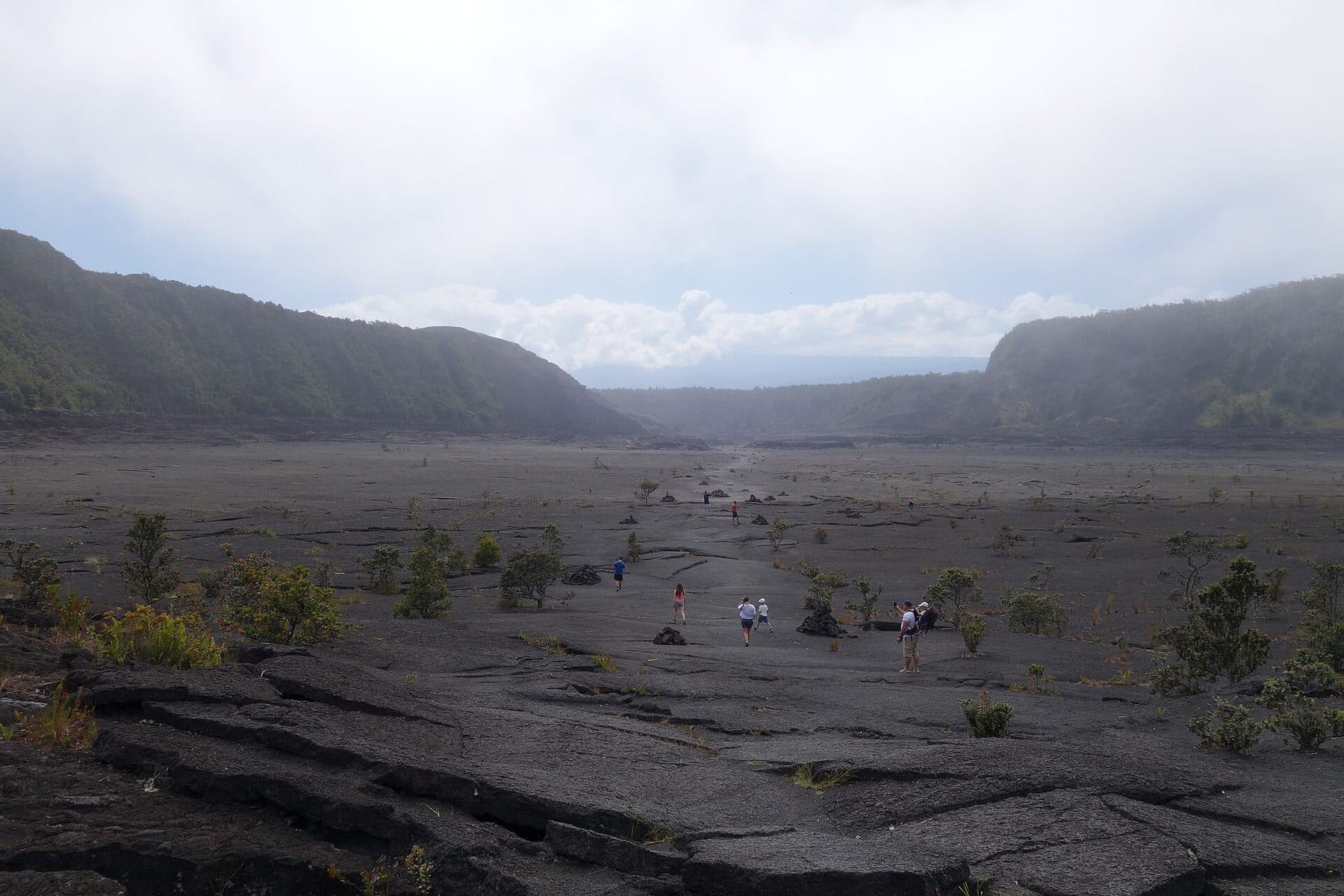
Hike Kīlauea Iki. If you do one hike in the park, make it this one. The trail is a 3.3-mile loop from Kīlauea Iki Overlook that drops 400 feet into the crater and climbs back out. Allow 2–3 hours. Overlook parking is extremely limited, so arrive early, or start at Devastation Trailhead for a 6-mile version.
Drive Chain of Craters Road. It runs 18.8 miles to the end of the road, where the summit’s cool air gives way to a hot, dry, windy coastal plain. There’s no food, water, or fuel anywhere along it. Vault toilets are at Maunaulu and at the end of the road, and there’s an emergency phone at the Puʻuloa petroglyph trailhead. Fill the tank and pack lunch before you turn onto it.
One landmark is gone. The Hōlei Sea Arch collapsed in late September 2026: it was standing on September 23 and gone by September 27. Stay out of the closed area around where it stood. Road access has shifted repeatedly after this year’s storms, so make sure Chain of Craters is open before you commit an afternoon to it.
Stay for dark. Any glow from the summit vents shows best after sunset. If HVO reports glow, head to Uēkahuna or Kīlauea Overlook with a headlamp and warm rain gear, as the park advises.
What to bring, and what vog means
- Layers and a rain shell. The summit can be 12–15°F cooler than sea level and rainy any time of year, while the coast at the bottom of Chain of Craters is hot and dry. Dress for both.
- Water and food. Nothing is sold on Chain of Craters Road.
- A headlamp for after dark, plus a flashlight for Nāhuku outside its lit hours.
- A dust mask and eye protection when the summit is fountaining. The park recommends both against tephra. In March 2026, fountains from episode 43 reached about 1,770 feet, and tephra closed Kīlauea Overlook and Uēkahuna for weeks.
- A plan for vog. Even during pauses, the summit gives off sulfur dioxide, which forms vog, and the National Park Service warns that volcanic gas can endanger sensitive groups. If you have a heart or breathing condition, or you’re pregnant or traveling with young children, check air quality before you go and keep checking while you’re in the park.
Leave every rock where it lies. The Hawaiʻi Tourism Authority notes that removing natural resources such as rocks and sand from the island is illegal.
Tour or drive yourself?
Drive yourself if you have a car and a night in Volcano or Hilo. Book a tour if you’re in Kona and don’t want the long round trip, or if you want a guide who knows each morning which overlooks are open. Our three favorites:
- A Kona-side day that loops in waterfalls.
- One that stays into twilight and adds stargazing. Our Maunakea guide explains that side of the island.
- A shorter Hilo-side day with Native Hawaiian guides.
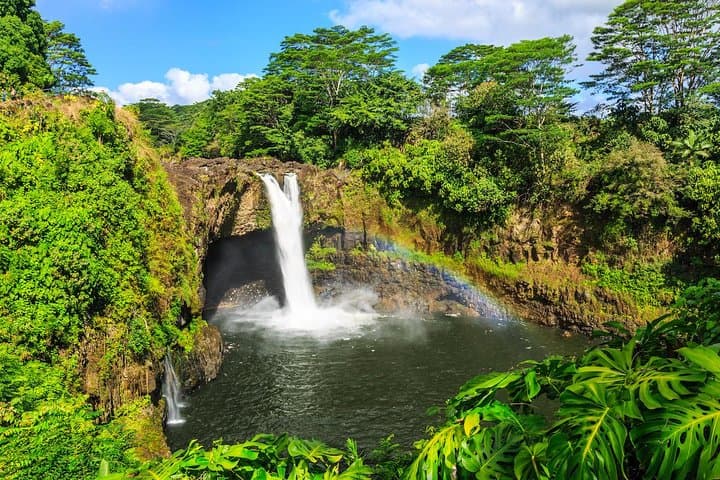 11 hours
Wasabi Tours Hawaii
Big Island in a Day: Volcanoes & Waterfalls
Hotel pickup in Kona & the Kohala Coast (6:40–8:00am); Queens' MarketPlace Waikōloa
Free cancellation
Booked securely on Viator
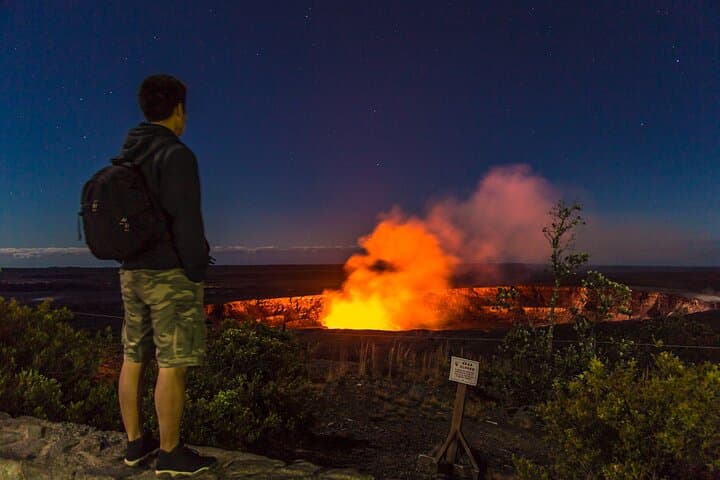 12 hours
Wasabi Tours Hawaii
Twilight Volcano & Stargazing Small-Group Tour
Hotel pickup in Kona & the Kohala Coast (9:30–10:30am)
Free cancellation
Booked securely on Viator
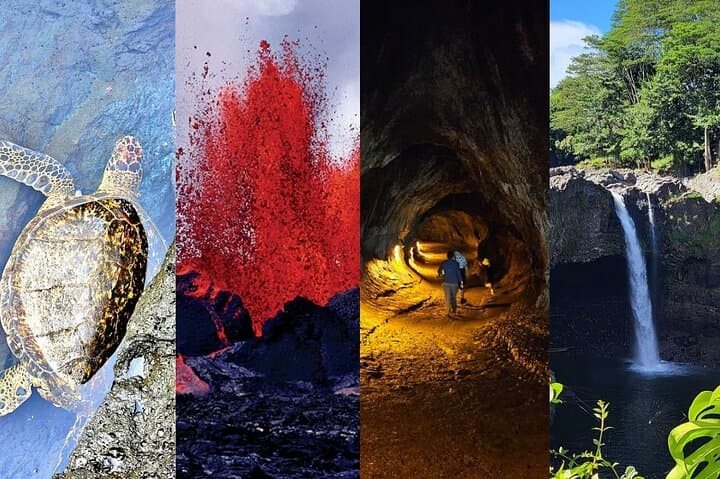 6–7 hours
Makaio Tours Hawaii
Volcanoes, Waterfalls & Hilo Highlights Day Tour
Hilo pickup: Port of Hilo, Hilo Airport, hotels, or Liliʻuokalani Gardens (Kona drivers)
Free cancellation
Booked securely on Viator
Group sizes, inclusions, and live prices for every volcano tour are side by side in our comparison.
Sleeping near the volcano
A night at the park’s edge changes the trip. You get sunrise on the crater rim, a night visit without the long drive back, and the trailheads before the day-trippers arrive.
Volcano House is the only hotel inside the park. Its 33 rooms sit on the rim of Kīlauea caldera, and the dining room looks out over Halemaʻumaʻu. The rooms are basic for the price; you’re paying for the rim. Kīlauea Lodge is our pick for comfort. It’s in Volcano Village, about a mile from the park entrance, built around a 1930s YMCA camp, with a restaurant and a fireplace that volcanologist Thomas Jaggar first lit in 1938.
Volcano Village sits at roughly 4,000 feet in the rain forest, so pack a sweater, and know that dinner options are few. See our Volcano region guide for the full picture, or search every stay in the area:
Rather see it from the air?
A helicopter covers lava fields no road reaches. Hilo is the closest helicopter base to Kīlauea, and Safari Helicopters’ Volcanic Safari spends about 55 minutes over the park. Compare it with every other flight on our helicopter tours page, and see how the park fits into a week in our 7-day Big Island itinerary.
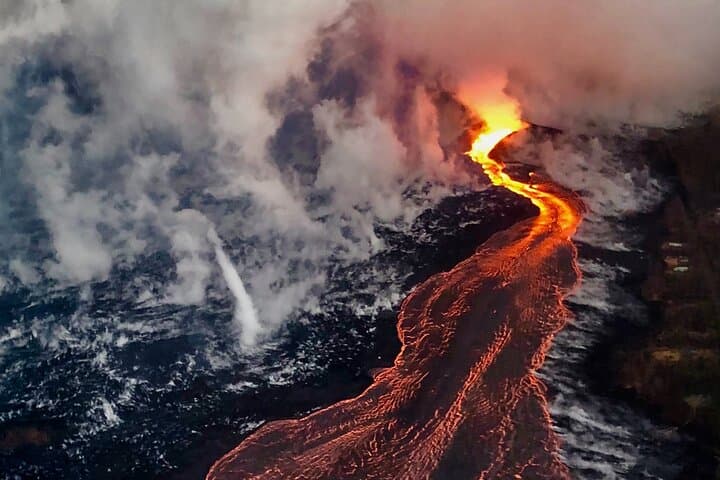
Photo: Zongnan Bao via Unsplash