This guide contains affiliate links. If you book through them we may earn a commission, at no extra cost to you. Learn more.
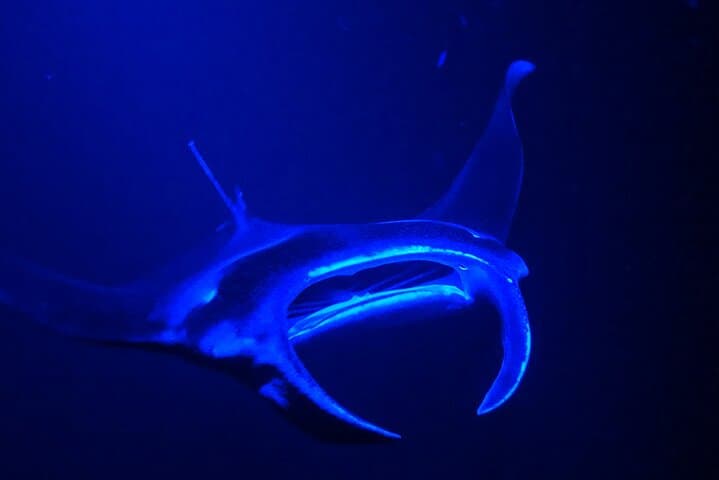
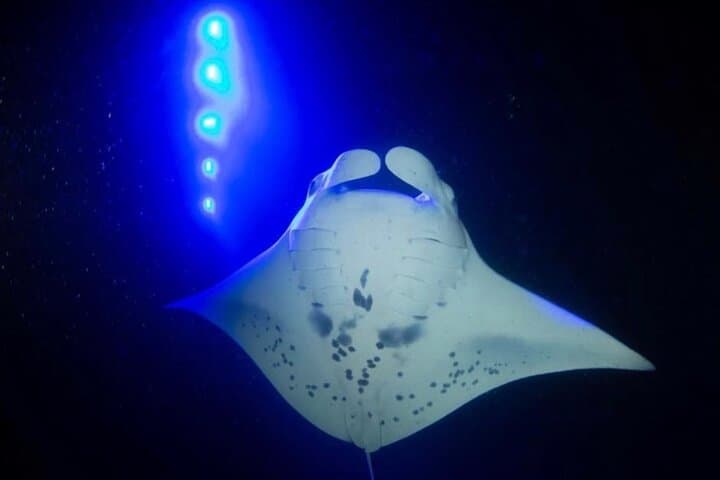
Picture floating in black water off the Kona coast while a manta ray swoops up out of the dark, mouth wide open, close enough that you pull your knees up without thinking. It’s the Big Island’s signature night out, and also the tour people are most nervous about booking.
So here’s the night from check-in to the ride home, plus who should get in the water and who should watch from the deck. If you just want the boats side by side, our manta tour comparison has them.
Before we board
Depending on the operator, we check in at Honokōhau Harbor, at Keauhou, or at an office on Aliʻi Drive in Kailua-Kona. Boats head out around sunset or after dark. We’d eat a real dinner first, because most trips serve only snacks. Wear a swimsuit under your clothes, and pack a towel and a warm layer for later.
The boat you pick shapes the ride:
- Small rafts out of Keauhou are only minutes from the site. They carry fewer people, but you feel every wave.
- Larger boats from Honokōhau Harbor are more comfortable, with more room and snacks, and they make a longer outing of it.
Prone to seasickness? Take your medicine before you board, not once the boat starts rocking.
Into the water
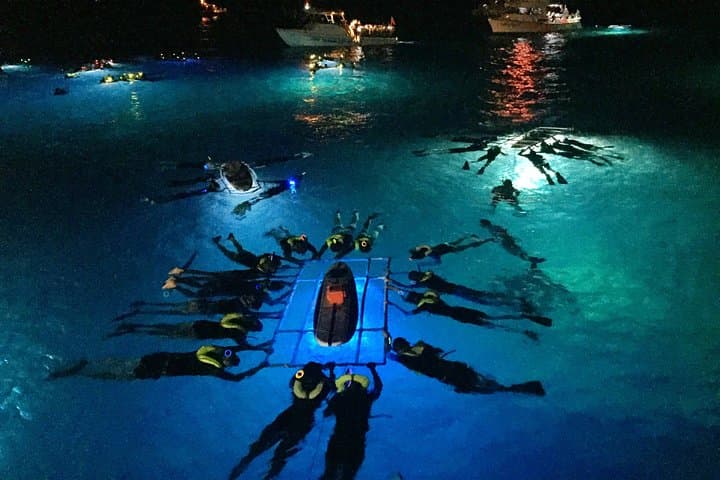
At the site, the crew hands out masks and snorkels and, on most trips, a wetsuit top. Several boats include flotation too. Then we slip in and take hold of a lighted float board with the rest of the group.
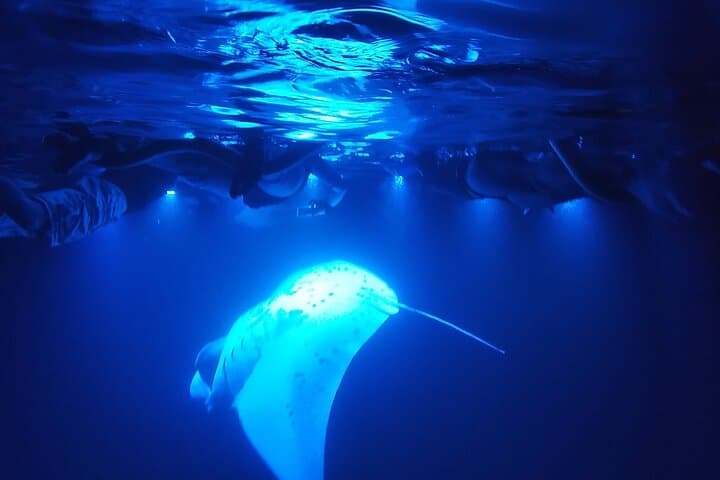
This next part is hard to describe well. The lights draw plankton, and the plankton draws the mantas. They feed in slow loops just beneath us, barrel-rolling up through the beams with their mouths open. Scuba divers settle on the bottom with their lights pointed up, so you often see a glowing circle of divers below the mantas.
We stay at the surface, faces down and legs stretched out horizontally behind us, with our lights aimed down. That isn’t just good technique. It’s the guideline every responsible operator follows.
How long you’re in depends on the trip. The short raft trips give you roughly 25–30 minutes in the water, and Dolphin Discoveries quotes about 30. The bigger boats vary, so check the listing. That’s long enough for the show and short enough that you’ll be glad of the warm layer afterward.
The ride home
Back on deck, wet skin and night wind add up fast, which is what that warm layer is for. Some boats serve something hot on the way in; Iruka Hawaii hands out hot cocoa. Then it’s back to the dock.
Who should swim, and who should ride along
You don’t need to be a strong swimmer, but you do need to be comfortable in deep water at night. You aren’t swimming laps. You float, holding a lighted board, usually in a wetsuit top with flotation. Each operator sets its own rules:
- Several require prior snorkeling experience, and Dolphin Discoveries also requires that you can swim and tread water.
- Age limits vary. Hang Loose takes ages 2–70, My Kona Adventures sets a minimum age of 5, and Dolphin Discoveries takes ages 6–70.
- Several boats aren’t suitable if you have a back or neck injury or a heart condition, or if you’re pregnant. Check the listing.
- Some boats set weight limits or require an extra seat above a certain weight.
Non-swimmers and nervous partners can book a ride-along ticket and watch from the deck. Hang Loose, Kona Coast Boat Tours, and Dolphin Discoveries all offer one. Iruka Hawaii sells separate Confident Swimmer and Beginner Snorkeler tickets.
Nerves: what helps
- Snorkel in daylight first. Get used to your mask in calm, shallow water at Kahaluʻu Beach Park, a beginner-friendly bay with lifeguards on duty daily.
- Know that mantas can’t hurt you. They have no stinging barb, and they feed on plankton. The risk runs the other way.
- Book early in your trip. Rough seas occasionally cancel tours, so an early date leaves room to reschedule.
- Skip the sunscreen. It’s dark.
Meet the mantas
Kona’s mantas are reef manta rays, Mobula alfredi, and they live here year-round. The Hawaiʻi Department of Land and Natural Resources (DLNR) names two viewing sites: Makako Bay (Garden Eel Cove) and the shoreline at Keauhou Bay. Long-term surveys cited by NOAA re-sighted most known individuals along the Kona coast over the years. Because the mantas are resident, tours run year-round.
No independent nightly sighting rate has been published, though. Any percentage you see in an ad is marketing.
The guidelines and the law
The Manta Pacific Research Foundation, a Kona nonprofit, first set viewing guidelines in 1993 and updated them in 2013. The core of them:
- No touching. Touching rubs off the mucus that protects a manta’s skin.
- Snorkelers stay on the surface, with legs horizontal and lights aimed down.
- Divers stay on or near the bottom, with lights aimed up.
Hawaiʻi law backs this up. No one may knowingly capture, take, possess, abuse, or entangle a ray, or kill any ray, in state marine waters. If a manta passes close, keep your hands to yourself and enjoy it.
How to choose a boat
If you want one name, it’s Hang Loose Boat Tours, the benchmark trip out of Honokōhau Harbor. It provides a wetsuit top and flotation and offers a non-swimmer ride-along. It also has a guarantee: if no mantas appear, your next trip is free.
The alternatives come down to boat size and fine print:
- Kona Coast Boat Tours caps its boat at 26 guests, a calmer pick for families.
- My Kona Adventures runs a small raft from Keauhou that reaches the site in 3–5 minutes, with a free re-ride if the mantas don’t show.
- Dolphin Discoveries has a five-minute ride to the site and sells a Manta Guarantee ticket.
 2.5 hours
Kona Coast Boat Tours
Manta Ray Night Snorkeling Adventure
Honokōhau Harbor (Kealakehe Pkwy), Kailua-Kona
Free cancellation
Booked securely on Viator
 1 hour 20 minutes
My Kona Adventures
Kona Manta Ray Night Snorkel (Free Re-Ride)
Keauhou (78-7138 Kaleiopapa St), Kailua-Kona
Free cancellation
Booked securely on Viator
 2 hours
Dolphin Discoveries
Manta Ray Night Snorkel, Sightings Guaranteed
Dolphin Discoveries check-in, Aliʻi Drive, Kailua-Kona
Free cancellation
Booked securely on Viator
Staying on the Kohala Coast? Iruka Hawaii offers paid pickup from the resorts there. Our comparison has every Kona manta tour side by side, with time in the water, guarantee terms, and live prices. For daytime trips, see our snorkel tour comparison.
The dry option: Outrigger Kona
Don’t want to get in at all? The OUTRIGGER Kona Resort & Spa sits above Keauhou Bay, where the original manta night dive began. The hotel, which was the Sheraton until 2021, has lit the water off its shoreline since the early 1970s, and on many nights you can watch mantas feeding from the hotel. Select oceanfront rooms overlook the viewing area, and its Manta Center hosts free talks on manta biology.
Every manta boat leaves from the Kona side, so that’s the natural base for a manta night. Weighing it against the other side of the island? Read Kona vs. Hilo: where to stay.
Here November through May? Pair your manta night with a day on the water from our whale watching guide, and find more ideas in the best things to do on the Big Island.