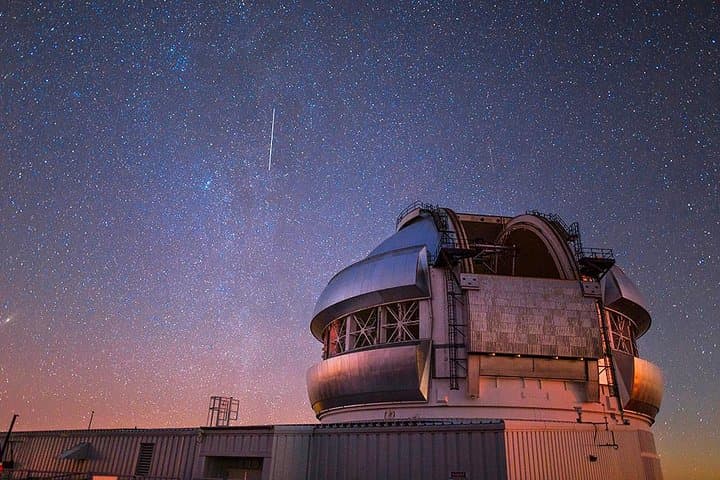
Maunakea's summit rises to 13,803 feet and is ringed by major observatories. Most visitors stop at the Visitor Information Station (VIS) at 9,200 feet, where staff may give a laser-guided sky talk after twilight, weather permitting; the old nightly telescope program ended in 2019. Above the VIS, only 4WD vehicles may continue.
Why we love it
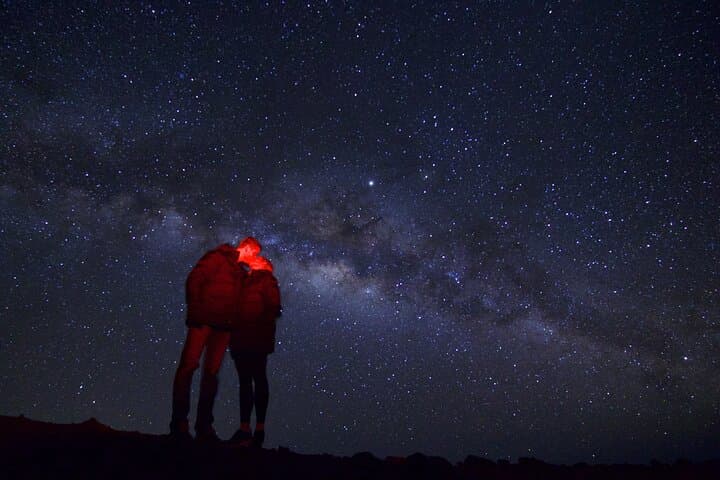
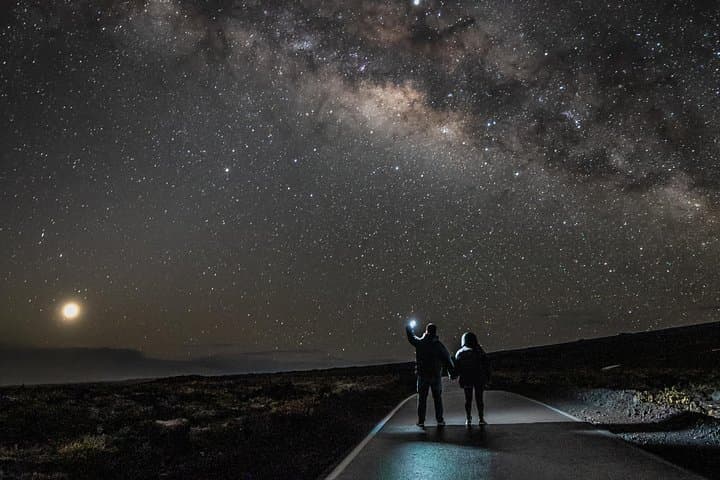
Watch the sunset above the clouds, then take in a sky full of stars at the VIS. It's one of the island's great free experiences. Respect the mountain: stay on the roads and leave every rock where you found it.
What to expect
The access road climbs off the Daniel K. Inouye Highway to the Onizuka Center for International Astronomy Visitor Information Station at 9,200 feet. Here, staff share safety and road information, and restrooms are outside at the back of the building. Most visitors stop at this level for sunset and stars. Above the VIS, the pavement ends after about 300 yards, and roughly 4.5 miles of steep graded gravel lead to the summit observatories at 13,803 feet, where oxygen is about 40% lower than at sea level. There’s no gas on the mountain. The nearest pumps are about 35 miles away, in Hilo, Waimea, or Waikōloa Village.
Know before you go
- Altitude
- Spend at least 30 minutes at the VIS before going higher. UH advises that children under 13, pregnant visitors, people with heart or respiratory conditions, and anyone who went scuba diving in the past 24 hours go no higher than the VIS.
- Driving
- Above the VIS, only dependable 4WD or AWD vehicles are allowed, and muddy vehicles are turned away. Ask your rental company whether you may drive on Maunakea. HTA recommends going to the summit only on a permitted tour.
- Hours
- The VIS is open 9 a.m.–9 p.m. every day, though UH posts occasional late openings. The summit is open from 30 minutes before sunrise to 30 minutes after sunset, after which stargazers must drop to Park 2 or lower.
- Stargazing
- There’s been no nightly public telescope program since 2019. Staff may give a laser-guided sky talk after twilight, depending on weather and staffing, and a free telescope night runs once a month by reservation.
- Phones
- Because of radio-telescope interference, cell phone use is limited to emergency calls. A public emergency phone is at the UH 2.2-meter telescope.
- Respect
- Maunakea is a wahi pana, and Lake Waiau is a very sacred site. Leave rocks and offerings at ahulele undisturbed. Snow sports, pets, and camping are not allowed.
Photo: Alex Eckermann via Unsplash